Common Aluminium Formwork Installation Challenges and Effective Solutions
Here we will discuss the common challenges associated with aluminium formwork installation and practical ways to overcome them.
Aluminium formwork has become an important construction technology for builders, contractors, developers, and infrastructure companies working on residential towers, commercial buildings, and large-scale projects. Its ability to support faster construction cycles, dimensional accuracy, consistent concrete finishes, and repeated usage makes it a preferred alternative to conventional shuttering methods.
However, achieving these advantages requires more than investing in a quality formwork system. Successful aluminium formwork installation depends on accurate engineering, proper planning, trained manpower, systematic material handling, and strict quality control at every stage of construction.
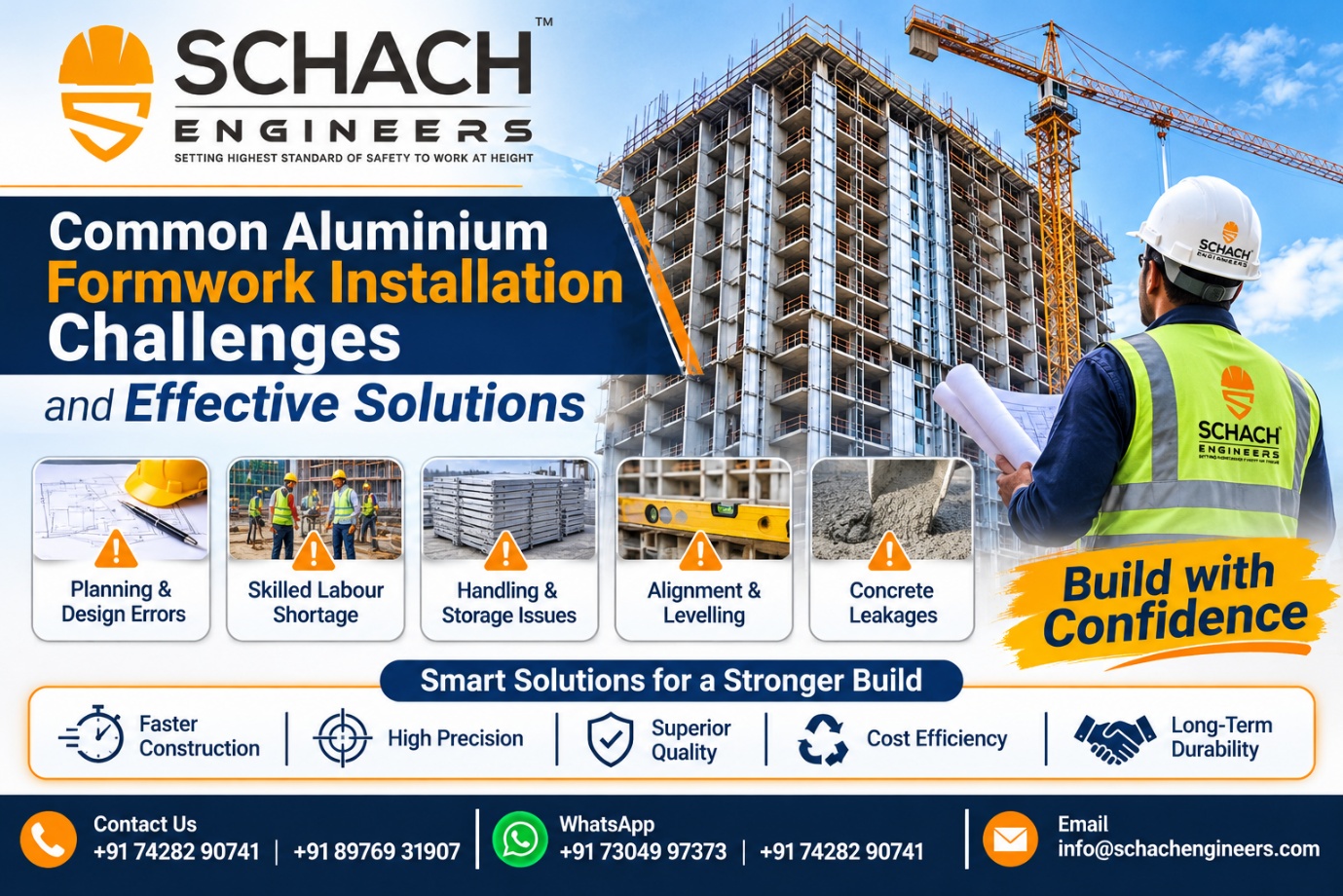
For high-rise construction projects, even minor installation errors can result in concrete leakages, dimensional variations, material damage, and unnecessary project delays. These problems can increase construction costs and affect the overall execution schedule.
Whether builders are sourcing materials from an aluminium formwork supplier in Mumbai or working with an aluminium formwork company in Pune, understanding these installation challenges is essential for achieving better project outcomes.
Schach Engineers focuses on engineered formwork and scaffolding solutions that support construction requirements through product quality, technical guidance, and project coordination. Here we will discuss the common challenges associated with aluminium formwork installation and practical ways to overcome them.
Inaccurate Planning and Formwork Layout Design
The challenge
Aluminium formwork is a precision-engineered construction system. Unlike conventional shuttering, its panels are manufactured according to specific architectural and structural drawings. Therefore, inaccurate planning during the initial stage can create significant complications during installation.
Incorrect measurements, incomplete drawings, and improper panel configurations may result in alignment problems, mismatched joints, unsuitable openings, and difficulties during concrete casting.
In high-rise projects involving repetitive floor layouts, an initial design error can affect several subsequent construction cycles.
How to overcome it
- Conduct detailed site assessments: Evaluate structural drawings, floor layouts, wall dimensions, slab thicknesses, and project-specific requirements before finalising the formwork design.
- Use digital design tools: BIM and other engineering design tools can help identify dimensional conflicts and coordination issues before manufacturing and installation.
- Prepare detailed shop drawings: Ensure that panel arrangements, corner connections, wall openings, slab configurations, and supporting components are properly documented.
- Coordinate with project engineers: Architects, structural consultants, and formwork designers should review the proposed layout before execution.
Builders should work with an experienced aluminium formwork manufacturer in Mumbai that understands the importance of drawing-based manufacturing and project-specific engineering.
Shortage of Skilled Labour and Technical Knowledge
The challenge
Aluminium formwork installation requires workers who understand panel identification, assembly sequences, joint connections, alignment, and dismantling procedures.
When workers are unfamiliar with the system, installation errors can become frequent. Incorrect panel positioning, missing accessories, improper connections, and unsuitable dismantling practices may affect construction quality and productivity.
This challenge becomes more significant when contractors introduce aluminium formwork for the first time.
How to overcome it
- Provide practical training: Workers should receive hands-on demonstrations covering panel identification, installation, connections, and dismantling.
Schach Engineers provides initial training and technical support to builders and contractors during the first-floor aluminium formwork installation and casting process. This guidance helps site teams understand panel identification, assembly procedures, alignment, connections, and installation practices, enabling them to follow the correct methodology before proceeding with subsequent floor cycles.
- Appoint experienced supervisors: Skilled supervisors should monitor installation activities and resolve technical issues.
- Follow installation drawings: Make approved panel layouts and assembly instructions accessible to the workforce.
- Implement stage-wise inspections: Check completed installation sections before proceeding to reinforcement checks and concrete pouring.
For builders and contractors, workforce training is an investment in construction efficiency. A properly trained team can reduce avoidable errors, minimise material damage, and improve the consistency of installation work.
Improper Handling and Storage of Aluminium Panels
The challenge
Aluminium formwork panels are designed for repeated use, but their service life depends significantly on how they are handled, cleaned, transported, and stored.
Rough handling, improper stacking, dragging panels across hard surfaces, and careless transportation can cause dents, deformation, and damage to panel edges.
Such damage may affect the fit between adjoining panels and create difficulties during subsequent installation cycles.
How to overcome it
- Use designated storage areas: Keep panels in organised, dry, and covered storage spaces.
- Stack panels systematically: Arrange panels according to their identification numbers, dimensions, and categories.
- Prevent physical damage: Avoid throwing, dragging, or placing heavy materials on aluminium panels.
- Clean after every use: Remove concrete residue using suitable cleaning methods without damaging the panel surface.
- Inspect before reuse: Check panel edges, connections, surfaces, and accessories before sending them back for installation.
A reliable aluminium formwork supplier in Mumbai should also help contractors understand appropriate handling and maintenance practices to protect their investment over multiple casting cycles.
Incorrect Panel Alignment and Levelling
The challenge
Accurate alignment is essential for achieving the intended dimensions and geometry of concrete structures.
If aluminium formwork panels are not installed according to approved drawings, walls may develop dimensional variations, slabs may have incorrect levels, and adjoining panels may not fit properly.
In high-rise buildings, small alignment errors can become more difficult to correct when repeated across multiple floors.
How to overcome it
- Use appropriate measuring equipment: Laser levels, plumb instruments, and measuring tools help verify horizontal and vertical alignment.
- Check wall dimensions: Confirm wall thicknesses, dimensions, and positions against approved structural drawings.
- Inspect panel connections: Ensure adjoining panels are properly connected using the specified pins, wedges, ties, and accessories.
- Verify before concreting: Conduct a final inspection to identify and correct alignment issues before concrete placement.
Contractors should establish a standard inspection procedure for every floor. Regular checks help maintain dimensional consistency and reduce the possibility of expensive corrections.
Concrete Leakage Through Panel Joints
The challenge
Concrete leakage is one of the common problems associated with improper aluminium formwork installation.
Gaps between adjoining panels, damaged joint surfaces, missing accessories, or inadequate connections can allow cement slurry to escape during concrete pouring.
This may create honeycombing, surface irregularities, material wastage, and additional repair work.
How to overcome it
- Inspect all panel joints: Check adjoining panel connections and contact surfaces before concrete placement.
- Ensure proper connections: Use the specified pins, wedges, ties, and other accessories to secure the formwork.
- Check damaged components: Replace or repair unsuitable panels and accessories before installation.
- Conduct pre-pour inspections: Examine corners, wall junctions, slab connections, and other potential leakage points.
- Follow approved concrete procedures: Ensure that concrete placement and vibration are carried out according to project specifications.
Preventing leakage before concreting is significantly more efficient than repairing defects after the concrete has hardened.
Incorrect Use of Formwork Accessories and Connections
The challenge
Aluminium formwork systems consist of different panels, wall ties, pins, wedges, props, and supporting accessories. Each component has a specific function in maintaining the stability and configuration of the formwork assembly.
Using incorrect accessories, missing connections, or improperly fitted components can compromise the formwork arrangement during concrete placement.
This can lead to panel displacement, joint openings, dimensional inconsistencies, and additional rectification work.
How to overcome it
- Identify every component: Organise panels and accessories according to the approved formwork drawings.
- Use compatible accessories: Ensure that all connections and supporting components are suitable for the specified system.
- Check connections systematically: Inspect pins, wedges, ties, props, and other fixing arrangements before pouring concrete.
- Maintain an accessory checklist: Verify that all required components are available and correctly installed.
Working with an experienced aluminium formwork company in Mumbai can help contractors understand system configurations, component requirements, and technical specifications before starting installation.
Difficulty in Coordinating Reinforcement, MEP and Concrete Activities
The challenge
Aluminium formwork installation is closely connected with reinforcement placement, electrical conduits, plumbing provisions, and concrete pouring.
If these activities are not properly coordinated, construction teams may encounter incorrect service openings, misplaced conduits, reinforcement clashes, and delays during formwork closure.
Such problems can require dismantling already installed panels, making corrections, and repeating installation activities.
How to overcome it
- Coordinate drawings in advance: Review architectural, structural, electrical, and plumbing drawings before beginning installation.
- Plan embedded services: Confirm the location of electrical conduits, switch boxes, plumbing sleeves, and other embedded components.
- Conduct joint inspections: Ensure that reinforcement and MEP provisions are checked before closing the formwork.
- Establish a construction sequence: Coordinate different teams according to a clearly defined floor-cycle schedule.
- Use pre-pour checklists: Verify all structural and service-related requirements before concrete placement.
Effective coordination between contractors, engineers, and site supervisors helps minimise rework and maintain construction schedules.
Premature or Improper Formwork Removal
The challenge
Dismantling aluminium formwork at the wrong time or following an incorrect sequence can damage panels and compromise the quality of the concrete structure.
Premature removal of supporting components may affect the structural performance of the newly cast concrete. Improper dismantling can also damage panel edges, connections, and accessories.
This is particularly important in high-rise projects where maintaining a planned floor-to-floor construction cycle is essential.
How to overcome it
- Follow the approved dismantling sequence: Remove panels and supporting components according to the project-specific method statement.
- Verify concrete strength: Ensure that the concrete has achieved the required strength before removing the relevant formwork or supports.
- Retain necessary props: Keep back-propping or other supporting arrangements as required by the structural engineer.
- Avoid forceful removal: Use appropriate tools and methods to prevent damage to panels.
- Inspect after dismantling: Check the panels for deformation, concrete deposits, and damaged accessories before reuse.
The dismantling process should always follow approved engineering instructions and applicable site safety procedures.
Maintaining Concrete Quality During Pouring and Vibration
The challenge
Even when aluminium formwork is installed correctly, improper concrete placement can affect the final structural quality.
Inadequate vibration may cause honeycombing and voids, while excessive or poorly controlled vibration can contribute to segregation. Incorrect pouring sequences and inadequate monitoring may also increase pressure-related risks for the formwork assembly.
How to overcome it
- Follow the approved concrete mix design: Use concrete that meets the project's specified requirements.
- Maintain a planned pouring sequence: Distribute concrete systematically according to the approved construction methodology.
- Use suitable vibration techniques: Ensure that trained workers use appropriate concrete vibration methods.
- Monitor formwork stability: Inspect panels, ties, supports, and connections during concrete placement.
- Follow engineering specifications: Ensure that concrete placement rates and formwork pressure limits are considered in the approved design.
Proper coordination between the concrete and formwork teams is essential for achieving consistent results.
Why Choosing the Right Aluminium Formwork Partner Matters
Selecting an aluminium formwork system is an important decision for builders and contractors. However, the quality of the overall solution also depends on manufacturing precision, engineering support, component compatibility, and timely material availability.
When evaluating an aluminium formwork company in Mumbai, construction businesses should consider more than the initial product price.
Important factors include:
- Manufacturing capabilities: Evaluate the manufacturer's production quality, material specifications, and dimensional accuracy.
- Engineering and design support: Check whether the company can develop formwork configurations according to project drawings and structural requirements.
- Product quality and durability: Assess panel construction, finishing, connections, and suitability for repeated use.
- Technical assistance: Look for a supplier that can provide installation guidance and technical coordination.
- Material availability and delivery: Reliable manufacturing and supply arrangements help contractors maintain project schedules.
- Project-specific solutions: The formwork system should be designed around the building layout, casting sequence, and construction requirements.
For projects in Maharashtra, builders comparing an aluminium formwork company in Pune with suppliers in other locations should evaluate engineering capabilities, product quality, delivery commitments, and technical support rather than relying on location or price alone.
How Schach Engineers Supports Modern Construction Requirements
Schach Engineers manufactures and supplies aluminium formwork, MS formwork, aluminium scaffolding, MS scaffolding, and perimeter safety screens for construction and infrastructure projects.
For builders, contractors, and developers, selecting the right formwork solution involves understanding the project's structural drawings, construction sequence, material requirements, and execution timelines.
Schach Engineers focuses on quality-engineered products, project coordination, and technical guidance to support customers in selecting suitable formwork and scaffolding solutions.
Whether a project involves high-rise residential towers, commercial developments, or large-scale infrastructure, proper product selection and systematic installation planning are essential for achieving construction efficiency.
Builders and contractors looking for an experienced aluminium formwork manufacturer in Mumbai or a dependable supplier for project requirements should evaluate the engineering specifications, manufacturing quality, and support available before finalising their formwork partner.
Aluminium formwork offers significant advantages for modern construction, but achieving its full potential requires careful planning, technical expertise, proper installation, and consistent quality control.
From inaccurate layout designs and untrained labour to concrete leakage, improper alignment, and material handling issues, every installation challenge needs to be addressed through a systematic approach.
For builders and contractors, the key is to combine quality-engineered formwork systems with trained installation teams, effective site coordination, and approved construction procedures.
Schach Engineers supports the construction industry with aluminium formwork and scaffolding solutions, technical guidance, and project coordination to help builders and contractors meet their project requirements.
Choosing the right formwork partner and following proper installation practices can help improve construction productivity, minimise avoidable rework, and maintain consistent quality across high-rise construction projects.
Frequently Asked Questions
What are the common problems faced during aluminium formwork installation?
Common aluminium formwork installation problems include incorrect panel alignment, inaccurate layout planning, concrete leakage, damaged panels, improper connections, shortage of skilled labour, and coordination issues. Proper training, engineering drawings, and pre-pour inspections help minimise these problems.
How can builders prevent concrete leakage in aluminium formwork?
Builders can prevent concrete leakage by ensuring proper panel connections, checking joints and corners, using the specified pins and wedges, inspecting damaged components, and conducting pre-pour quality checks. Proper concrete placement and vibration techniques are equally important.
What precautions should be taken while installing Mivan formwork?
Mivan formwork installation requires accurate measurements, approved layout drawings, properly connected panels, suitable supporting arrangements, and trained workers. Contractors should also inspect reinforcement, electrical conduits, plumbing provisions, and formwork stability before concrete pouring.
How can aluminium formwork panels be maintained for repeated use?
Aluminium formwork panels should be cleaned after every casting cycle, inspected for dents and deformation, handled carefully, and stored in organised, covered areas. Damaged accessories should be replaced, and suitable maintenance practices should be followed to extend panel service life.
How do I choose the right aluminium formwork manufacturer in Mumbai?
Builders and contractors should evaluate manufacturing quality, aluminium specifications, engineering and design capabilities, panel durability, customisation, technical assistance, and delivery commitments. Selecting an experienced aluminium formwork manufacturer in Mumbai can help ensure that the system meets project-specific construction requirements.