
Planning an Aluminium Formwork Floor Cycle Without Treating It as a Guarantee
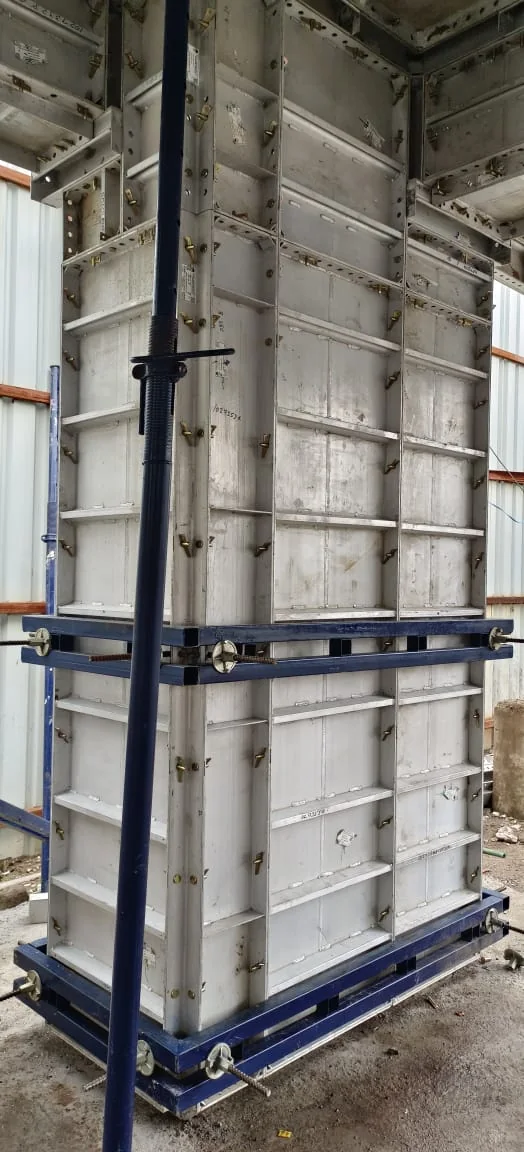
Aluminium monolithic formwork is often discussed through a single cycle-time number. That number is useful only when the project team also understands what happens before the typical floor becomes repetitive. The Schach monolithic catalogue gives reference ranges for early slabs and typical floors, while making clear that manpower and project conditions affect the programme.
The cycle begins before material reaches site
The production workflow starts with good-for-construction drawings, shell-plan preparation, client review, modulation, fabrication drawings, and the bill of quantities. A late architectural or structural revision can move through panel design, accessories, packing, and erection sequence. Freezing the right information early is therefore part of cycle planning, not only a design-office activity.
Why the first slab takes longer
The catalogue presents approximately 20 to 25 days for the first slab and approximately 10 to 15 days for the second slab, subject to manpower availability. The first cycle includes unloading, sorting, identifying panels, learning the erection sequence, checking interfaces, aligning walls and decks, and resolving project-specific details. The second cycle benefits from that learning but may still require adjustments.
The typical-floor reference
Once the system, team, and sequence are stable, the catalogue gives a reference typical-floor cycle of 7 to 8 days. This should be treated as a planning basis rather than a blanket promise. Floor geometry, repetition, concrete supply, reinforcement, embeds, services, inspection hold points, crane or hoist access, weather, and crew continuity all influence the achieved cycle.
Striking windows are one part of the programme
The same catalogue references vertical formwork striking at roughly 12 to 24 hours and horizontal deck formwork at roughly 36 to 72 hours. Actual striking must follow the approved method statement, concrete-strength requirements, structural design, reshoring plan, and site authorization. Faster handling is never a substitute for confirmed concrete performance.
Plan the work as connected zones
Break the floor into wall, slab, staircase, core, shaft, opening, balcony, and non-typical zones. Identify which panels repeat unchanged and which require special handling. Coordinate reinforcement, MEP embeds, external platforms, safety screens, concrete access, and inspection points against the same sequence.
Measure the first cycles
Record crew size, panel movement, waiting time, missing components, alignment corrections, concrete start and finish, striking, cleaning, and the handover between trades. The useful target is not merely a fast pour. It is a repeatable cycle that can be executed safely while protecting panel condition and concrete quality.
Share the latest drawings, repetition schedule, target cycle, planned manpower, and logistics constraints when requesting a monolithic formwork proposal.